
The first in a six-part series on the readiness gaps AI is exposing — and why they all land on HR. This installment: the hidden cost of undocumented expertise.
The overview article for this series drew the map: AI’s last mile — the stretch from a working pilot to a number that actually shows up on the income statement — isn’t one gap but six, and not one of them is, at its core, a technology problem. Every one lands on the CHRO’s desk. We begin where the last mile itself begins.
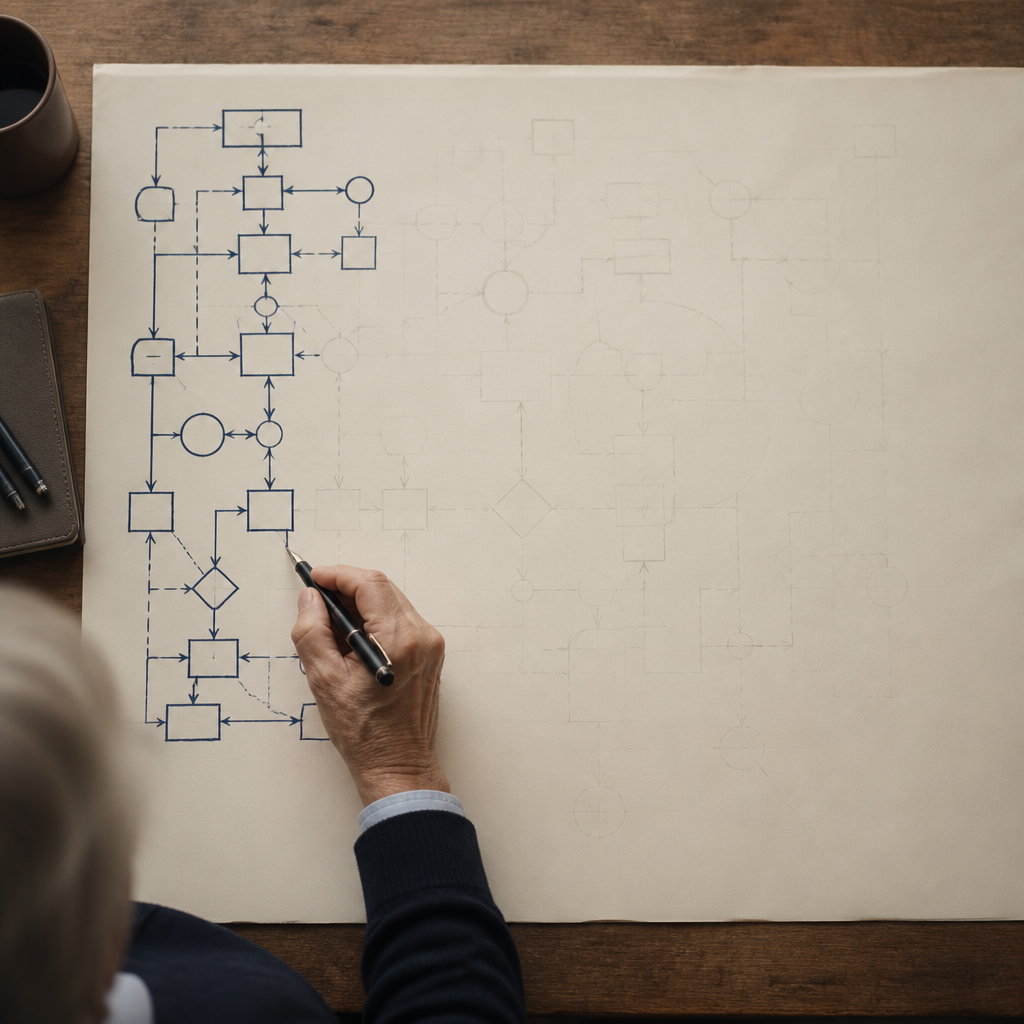
The first gap is the knowledge that was never written down. The HRBP who knows why a particular leader’s hires always get promoted. The benefits specialist who remembers how a 2019 policy exception still applies to the division you acquired in 2024. The ops lead who routes every Q4 request around an approval chain that has been broken since the last reorganization. Freeing that knowledge — getting it out of heads and into a form AI can use — is where the last mile begins.
Roughly 80% of how a typical enterprise actually works is undocumented, living in the judgment of experienced people and the way they adapt under real conditions. That is the raw material AI needs, and most of it is locked away.
Why it stays locked
It is locked for a human reason, not a technical one. For decades, expertise meant being the person who knew; now AI asks those same people to externalize their judgment into a system, and many suspect that the moment they finish, they will matter less. The fear is rational, and costly. In a field experiment, the economist David Almog found that when workers’ reliance on AI was made visible to an evaluator, they used it less, performed worse, and lost roughly one in four successful human-AI collaborations, because they feared that visible reliance signaled weak judgment.
This is the CHRO’s territory, because the unlock is not technical. Engineering and IT can build the capture; only HR can design the role architecture, recognition, and career paths that make codifying your judgment feel like legacy-building and career acceleration rather than digging your own grave. The firms that get it reframe senior experts as the architects and stewards of the judgment that will run the company for the next decade and create higher-status roles, not hollowed-out ones. As Ethan Mollick puts it, “a Claude-run company has no source of competitive advantage compared to other Claude-run firms”; the moat organizations can build is in reimagining work to keep humans in it, not automating them out of it. Landing that shift starts with what the ethnographer Craig Honick and the Good People Research team call the Guiding Narrative® — the story each person tells about their work and their role. Surface that story and a reframing lands; skip it, and “become an AI knowledge steward” is just a slogan.
What willingness can’t fix
But willingness only takes you part of the way, for two reasons, and both are why a human stays in the loop. The first is a ceiling on what can be told at all. “We know more than we can tell,” the philosopher Michael Polanyi observed: the deepest expertise is tacit, and AI-moderated capture skews toward the articulate, missing behavior and the unsaid. Getting tacit judgment into explicit form — what knowledge theorists call externalization — is the hardest step there is, and some of it never fully makes the trip.
The second reason surfaces the moment you turn an agent loose on a real workflow: the process itself was never built to run without a human in it. AI is a ruthless diagnostic flashlight. One large healthcare insurer found workflows so fragmented that AI surfaced contradictions faster than anyone could resolve them; a global professional-services firm discovered the “same” process was being run dozens of ways. These processes were designed for humans who knew who to ask and when a rule did not apply; the workarounds were the intelligence. Hand them to an agent and it either freezes at every undocumented step or routes every ambiguity back to the few people who hold the tribal knowledge. The bottleneck does not vanish — it lands on the people least able to absorb it. If your AI process needs a senior expert to unstick it at every turn, you do not have an AI-enabled process. You have a new escalation queue.
Redesign the work, don’t extract it
So the goal is not to extract everything. Polanyi says you cannot, and the process says you should not try. It is to redesign the work for human-AI collaboration: use AI-assisted interviewing to free the knowledge that can be freed, draw an explicit line where human judgment takes over, and keep a person on the irreducibly tacit calls and the genuine exceptions. Do that, then documentation becomes architecture and your experts’ judgment becomes a durable advantage instead of a bottleneck.
Next: the other half of the problem
Cross this gap and the knowledge trapped in your people’s heads becomes an asset AI can build on. But heads are only half the readiness problem. The other half lives in your systems — the data an agent has to reason over — and it is where HR turns out to be more exposed than almost any other function. That is where the series goes next.
People-AI-HR helps organizations cross these gaps in the right order, and fast. Our Six-Gap Readiness Scan benchmarks your function across all six dimensions in three weeks and pinpoints the one workflow, one team, one month where you should begin. Often a 30-minute conversation is enough to tell. Schedule one with founder Dirk Petersen to explore how your HR team can bridge Gap 1 with Sprint 01—Knowledge Architecture: The Hidden Cost of Undocumented Expertise.
Next in the series: Gap 2 — Data: Where HR Is Disproportionately Exposed.
Leave a Reply