
Audit
Six-Gap Readiness Scan
3 Weeks · Fixed Fee
When your CEO asks whether HR is ready for AI, you need an answer you can prove.
Most HR teams have tried something with AI by now: a tool, a pilot, a Copilot rollout. Many of them stalled. And when leadership asks why, the honest answer is usually: we’re not sure.
That uncertainty is the real problem. AI doesn’t stall in HR because the technology is bad. It fails because one of six things underneath it wasn’t ready — the data, the processes, the tools, the people, the rules, or the managers — and no one knew which one to fix first.
The Six-Gap Readiness Scan checks all six in three weeks, scores where you stand on each, compares you to similar organizations, and gives you a clear, defensible answer to the only question that matters right now: “Where do we start?”
The Problem This Solves
AI isn’t exposing one gap in HR. It’s exposing six.
The hardest part of AI is the long final stretch of turning a pilot into everyday results that show up in the business.
Industry research is blunt about how often organizations don’t make it: Gartner estimates that roughly 60% of AI projects do not reach real production. Not because the technology failed, but because the organization wasn’t ready.
For HR, that readiness breaks down into six specific gaps. Any one of them can sink an AI effort and they tend to land on the same desk:
Your AI tools keep getting stuck and bouncing work back to the same few senior people, because how the work really gets done lives in their heads; processes and procedures are not well documented
Gap 2
Data Quality
HR and Finance each use a different people count. An AI tool can’t reason over data that doesn’t agree with itself, or is incomplete
Gap 3
Vendor Selection & Coordination
Several AI-enabled systems are now in use with no clear “main” one, no shared rules, no AI-coordination, and a software renewal is coming up that nobody has fully thought through
Gap 4
Employee Capacity & Adoption
Lots of people have access to AI tools, but results are flat — and the rollout has created more anxiety than productivity
Gap 5
AI Governance
There are no clear rules for what AI is allowed to decide, no record of those decisions, and no confident answer if a regulator or your board asks
Gap 6
Manager Role
Your front-line managers are where AI adoption actually succeeds or fails and they’re the least prepared group in the building for the changes AI brings
These six gaps are connected.
Fix the data while the rules are still missing, and the messy AI output comes right back.
Train the managers before the processes are written down, and there’s nothing solid for them to manage.
So the order you tackle them in isn’t a detail — it’s the whole game. And spending real money to close the wrong gap first is the most expensive mistake on the table.
The Scan exists so you never have to guess which gap should be closed first.
Read the deep-dive Insight series:
The Six Company Readiness Gaps AI Is Exposing, and
Why They All Lead to HR
What the Scan Is:
A clear, board-ready decision—in three weeks.
The Scan is an independent, outside-in look at all six gaps. We score each one against what “AI-ready” actually requires, set your scores side by side with similar organizations (drawn from our own client work and from published research by groups like BCG, EY, and the World Economic Forum), and turn the result into a single, defensible decision about where to begin.
Your CEO, CFO, and board aren’t asking HR, “Where should we start?” They’re asking harder questions — the kind that are uncomfortable without evidence behind your answer:
- “Are we ready for AI, or are we going to get caught out?”
- “Everyone’s promising productivity gains. Where are ours, and how will you prove them?”
- “Are we exposed on bias, on the new AI regulations, legally?”
- “Are we falling behind our competitors?”
Outcome
The Scan is deliberately not a 60-page report that gets read once and shelved. It gives you the evidence to answer those questions head-on. And it settles the question HR has to answer internally before any of that improves: “Where do we start, and in what order?”
Deliverables
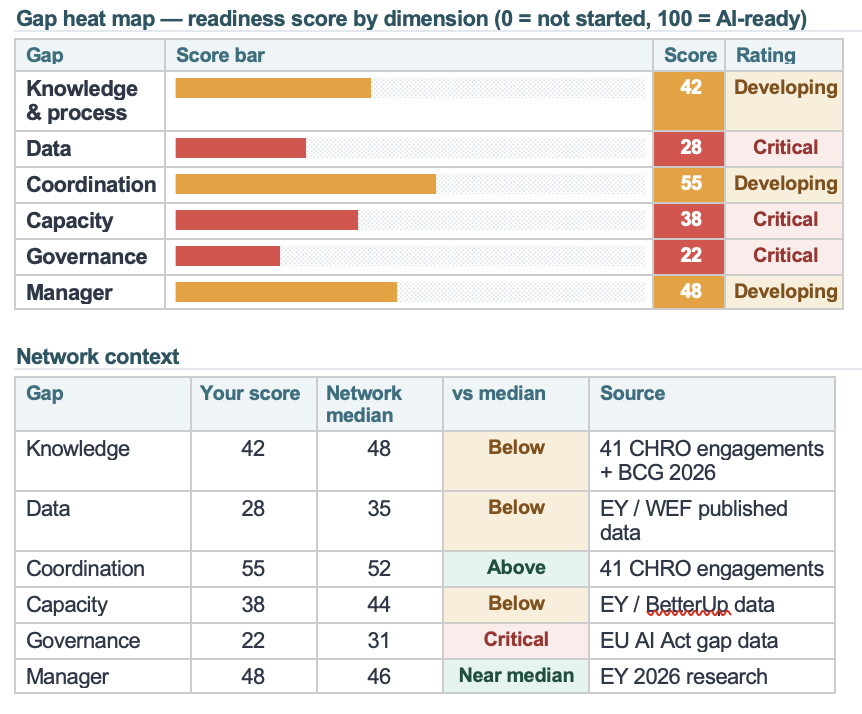
- A six-gap scorecard: your readiness on each of the six dimensions, on a simple 0-to-100 scale, so leadership can see the whole picture on a single page
- A peer comparison: your score against the typical score for each gap, so the result is evidence you can stand behind, not one consultant’s opinion
- A prioritized, justified plan: which gap to close first, second, and third, and why — written for a CEO, CFO, and board to read and approve
- A first-project plan: one real piece of work, chosen because its results can be measured cleanly before and after, ready for your team to start
How It Works:
- Week 1 — Set the target
A short kickoff with you, brief input from a handful of key people, and a look at the information we can review without disrupting anyone’s week. - Week 2 — Score and compare
We rate each of the six gaps, run the peer comparison, and map how the gaps affect one another — where fixing one unblocks (or stalls) the next. - Week 3 — Make the decision
We walk you and your leadership team through the scorecard, the recommended order, and the first project in one working session. You leave having made the call
The total time required from your executives is measured in hours, not days.
What happens after the Scan?
The Scan is where every engagement begins. Based on what it finds, you move into one of two paths — and you’re never obligated to do everything.
Focused projects (“Sprints”) — fixed scope, fixed fee. Each one closes a single gap. You can do just one, or run several in the order the Scan recommends:
The project (“Sprint”)
The gap it closes
Duration
The Full Program
For the HR leader who wants the whole system moving at once: a six-month engagement that includes the Scan plus three projects in the right order, a monthly progress dashboard written in business terms for your CEO and CFO, and quarterly check-ins.
You walk into the board meeting six months in with a clear before-and-after story across all six gaps, backed by evidence:
Who It’s For
The Scan is built for mid-sized and growing organizations (roughly 200–5,000 employees) where HR has the backing of senior leadership and is ready to act. It’s the right first step when:
- Something with AI stalled, and figuring out why turned into an argument no one could settle.
- Your CEO has asked, out loud, whether HR is ready for AI — and you want a real answer, not a hopeful one.
- You’re about to spend money on a tool, a project, or a contract renewal, and you’re not certain it’s the right first thing.
Who’s Behind It
People-AI-HR LLC was founded by Dirk Petersen, who has spent his career helping HR leaders deliver real business results through their people, from hands-on entrepreneurial leadership to senior HR roles at the World Bank, Gartner, and Insight222.
“I believe HR has never had a bigger opportunity—or a bigger risk. If HR leads with AI, it will help define the future of work. If not, someone else will.”
Three weeks from now, the decision can be made.
Scored across all six gaps.
Compared to your peers.
Clear enough to defend to your board.