Sprint 05
Set the Rules
Governance: Set the Rules Before You Scale
6 Weeks · Fixed Fee
In most organizations, AI adoption moves faster than the rules that are meant to govern it. A few teams pilot a tool, a vendor’s AI layer switches on inside an existing system, and before long, decisions that affect employees are being shaped by systems no one has formally authorized. The policies that should guide them get written after the fact—if they get written at all.
You don’t need agents running across the enterprise for this to matter. The smartest moment to define your governance model is before you scale: while the stakes are still small, the workflows are still few, and the decisions are still yours to design rather than untangle. Governance set up early is a foundation, while governance retrofitted under pressure is a cleanup project; a far more expensive one.
The Questions to Answer Before You Scale Your AI
Governance becomes concrete the moment you ask the questions many HR functions haven’t yet faced:
- When you put AI into a hiring workflow, who will have sign-off authority over its recommendations?
- If a performance-management model produces an outcome no one can explain, what happens next?
- Who will own the audit trail when an agent approves something—a leave request, an exception, a flagged candidate—outside business hours?
Most organizations can’t answer these today, and that’s understandable: the situations haven’t fully arrived yet. But that’s precisely the opportunity. Deciding these things now, deliberately, is far cheaper and far more defensible than improvising them the first time a decision is challenged and no one can say who made it, on what basis, or who signed off.
Why AI Governance Is Really About Trust—and Why That Makes It HR’s Job
AI governance cannot wait until the technology settles. Critical HR applications—recruitment, performance evaluation, and workforce monitoring—are high-risk systems requiring explicit human oversight and audit trails. An AI-influenced hiring or termination decision that cannot be defended is a catastrophic litigation risk.
Governance is the infrastructure of trust. Without it, employee distrust feeds the Fear of Becoming Obsolete (FOBO), stalling adoption.
This belongs to the CHRO. Legal identifies risk but is not trained or incentivized to weigh business benefits; IT controls infrastructure but not people policy. The CHRO must lead the work: defining decision rights, building review mechanisms, and creating the culture of explainability that makes AI sustainable.
The Solution:
Build AI Governance You Can Operate
Most AI governance efforts fail in one of two directions: a compliance document so abstract that no one uses it, or a one-time policy that’s outdated the moment the next LLM model version ships.
The Governance sprint is built to produce something your organization can run—and keep running as the tools and your adoption evolve:
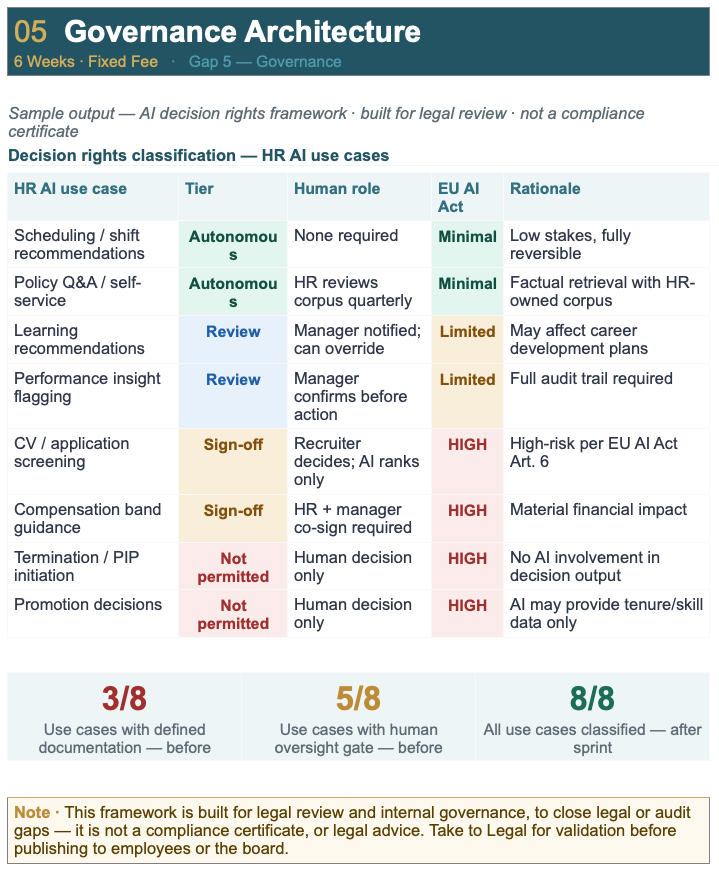
- We start with the decisions, not the technology — mapping which HR decisions carry real consequence for employees, and classifying which ones AI should be allowed to make, which it may only assist, and which must stay human.
- Then we overlay where AI is already touching those decisions in your environment—including vendor AI layers switched on inside systems you already own—which is almost always more than leaders expect.
- From there, we build a decision-rights framework: a clear taxonomy of which AI decisions require human sign-off and which can run autonomously, with named accountability for each. We define a published explainability standard so employees can understand how algorithmic recommendations are made. And we establish an audit cycle that treats AI-augmented workflows the way your finance team treats internal controls—as an ongoing discipline, not a project that ends.
Outcome
The output isn’t a binder. It’s a working governance model your HR, Legal, and IT teams can hold the line on together—ready before you scale, not after.
Deliverables
- Decision rights framework: a clear taxonomy of which AI decisions require human sign-off and which can run autonomously, with named accountability and escalation paths for each category
- Explainability standard: a published standard for how algorithmic recommendations are surfaced and explained to employees, so trust is built rather than eroded as adoption grows
- AI Decision gap assessment: a mapping of your current and planned high-risk HR applications against emerging regulatory requirements, including the EU AI Act’s human-oversight, transparency, and audit-trail standards
- Audit protocol (draft): a recurring review cycle that treats AI-augmented workflows like financial internal controls, with defined cadence, ownership, and evidence requirements that your legal team can utilize to develop a defensible protocol
Example: Before and After a Governance Sprint