
Sprint 06
Redesign the Manager Role
Why Managing in an AI-Powered Organization Is a Different Job
8 Weeks · Fixed Fee
The manager gap is easy to mistake for an overload problem. Overload is real and measurable—but it isn’t the core issue. The core issue is that the job of management is being structurally redefined, and almost no organization has actually told its managers that.
What it means to set direction, delegate, evaluate performance, develop talent, and hold a team together looks materially different when part of that team is software. Yet the role description, the performance standards, and the development path most managers are working against were written for an all-human team.
So managers experience the shift the only way an undefined change can be experienced: as personal exhaustion, and a private suspicion that they’re falling behind. It isn’t a personal failing; it’s an organizational design problem. And it is the most underappreciated of the six gaps, because it’s the fulcrum on which every other gap turns.
Managers Feel a Confidence Gap; it Holds a Talent Warning for Your Organization
Manager exhaustion is not a weakness; it is a structural failure. Overseeing AI agents causes severe mental fatigue and information overload, something that’s being called “AI brain fry”.
AI doesn’t reduce work—it intensifies it. As tasks accelerate, recovery space collapses, leaving managers with more output to review, more decisions to arbitrate, and less time to do either well. Buying more tools without redesigning the job simply turns up the pressure.
Every AI agent is, functionally, a new employee—but one with a skill profile that changes with every update and failure modes that defy human intuition. Managing a workforce that is part software demands entirely new capabilities, yet almost no organization is actively supporting managers through this shift.
The consequences are catastrophic: the majority of your management layer is openly uncertain about the central task of the next decade, and the leadership pipeline is draining. When your most capable individual contributors look at the manager job and decline the promotion, you don’t have a development problem. You have a role that has become fundamentally unsustainable.
This is the gap every other gap depends on. Handing this to a training vendor won’t work; a leadership workshop with an AI module bolted on doesn’t change the job. Owning this crisis means genuinely re-architecting the manager role: defining new capabilities, updating performance standards, and building an infrastructure where leaders can actually succeed.
Redefining this role sits squarely with the CHRO. Redesign the manager role first, and you build the leadership infrastructure your entire enterprise transformation depends on.
The Solution:
Redesign the Manager Role—Don’t Just Train Managers
Most efforts to ‘train managers for AI’ fail in one of two directions: a generic AI-leadership workshop that inspires for a week and changes nothing, or a new competency model that lives in a document no manager ever uses.
The Manager Role Redesign sprint is built to change the actual job—the role, the standards, and the capabilities—for a real cohort of managers, in a way your HR team can extend to the rest:
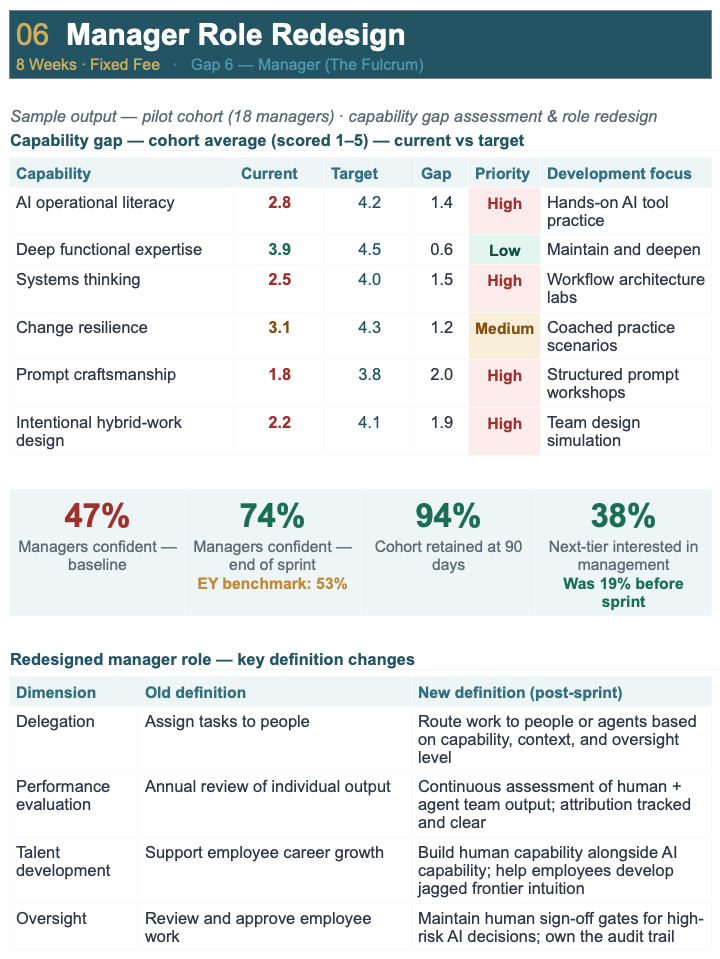
- We start by assessing your managers against the capabilities the hybrid role actually requires — not a generic leadership rubric, but the specific blend of AI operational literacy, functional depth, systems thinking, resilience, prompt craft, and hybrid-work design that managing people-plus-agents demands. That assessment shows you, concretely, where your management layer stands and where the gaps concentrate.
- Then we redesign the role itself: an updated definition of what a manager is accountable for when part of the team is software, paired with performance standards that measure the new work rather than the old.
- From there, we build a development curriculum targeted to the specific gaps the assessment surfaced, and we run it with a live cohort of managers so the learning happens against real teams and real agents, rather than in the abstract. The technology stays with your people; what we deliver is the redefined role, the standards, the curriculum, and a proven cohort your HR team can scale from.
Outcome
The result isn’t managers who’ve heard a talk about AI. It’s a redesigned management role your people can actually succeed at—and a first cohort who can show the rest of the organization what leading an AI-augmented team looks like in practice.
Deliverables
- Manager capability assessment: a scored read of your management layer against the six capabilities the hybrid role requires, showing where readiness is strong, where the gaps concentrate, and which managers are positioned to lead the transition
- Redesigned manager role and performance standards: an updated definition of what a manager is accountable for when the team includes AI agents, paired with performance criteria that measure the new work (agent oversight, hybrid-team design, decision quality) rather than the work the old standards assumed
- Manager development curriculum: a targeted learning path built around the specific capability gaps the assessment surfaced, designed for your HR or L&D team to re-run with future cohorts rather than depend on us to deliver
- Cohort report: the documented results from the first manager cohort run through the redesigned role and curriculum: capability movement, what changed in practice, and the playbook for extending it across the rest of your management population
Example: Before and After a Manager Role Redesign Sprint
Employees fear sharing what they know.