Sprint 01
Free the Knowledge
Knowledge Architecture: The Hidden Cost of Undocumented Expertise
6 Weeks · Fixed Fee
Roughly 70–80% of the operational know-how inside a typical company lives entirely in people’s heads — in the spontaneous judgment of experienced employees, in the way they interpret policy, how they route exceptions, and their network of collegues they call on to help when the formal process doesn’t cover the situation.
That knowledge isn’t undocumented because people are disorganized. It’s undocumented because for decades, it’s been the most efficient way of operating.
Being the person who knows has been the job. AI now asks those same people to externalize their judgment and encode it into a system — and without addressing what that means for them, the initiative stalls even before it starts.
Read the deep-dive Insight article: Gap 1: Knowledge & Process
What Happens When AI Hits an Undocumented Process
When you introduce AI into a real workflow, something useful happens first: it acts as a diagnostic flashlight, exposing the brittleness underneath.
Processes that appeared to function smoothly turn out to be held together by a handful of people making dozens of undocumented judgment calls every day.
That’s not an AI problem. It’s a process architecture problem that AI just made visible and impossible to ignore.
If an AI-assisted process depends on a small number of senior people to unstick the agent every time it hits an undocumented step, you don’t have an AI-enabled process.
The Solution:
Combine Identity with Process
Most solution providers treat documentation as a technical exercise, and identity as a change management add-on. We address them simultaneously, because one without the other doesn’t hold:
- We start by mapping the Guiding Narrative® of the key knowledge holders — the internal story each person tells themselves about their work, their role, and their value. Understanding that narrative is the precondition for designing a reframing that actually lands.
- We use an AI-assisted diagnostic to surface the undocumented steps, the workarounds, the exceptions, and the informal decision trees that make your process run. We then rebuild those workflows from the ground up with AI-human collaboration at the center.
Outcome
Experienced employees move from being the bottleneck to being the architect. Their judgment becomes the competitive advantage for your organization that trains and governs the system.
Deliverables
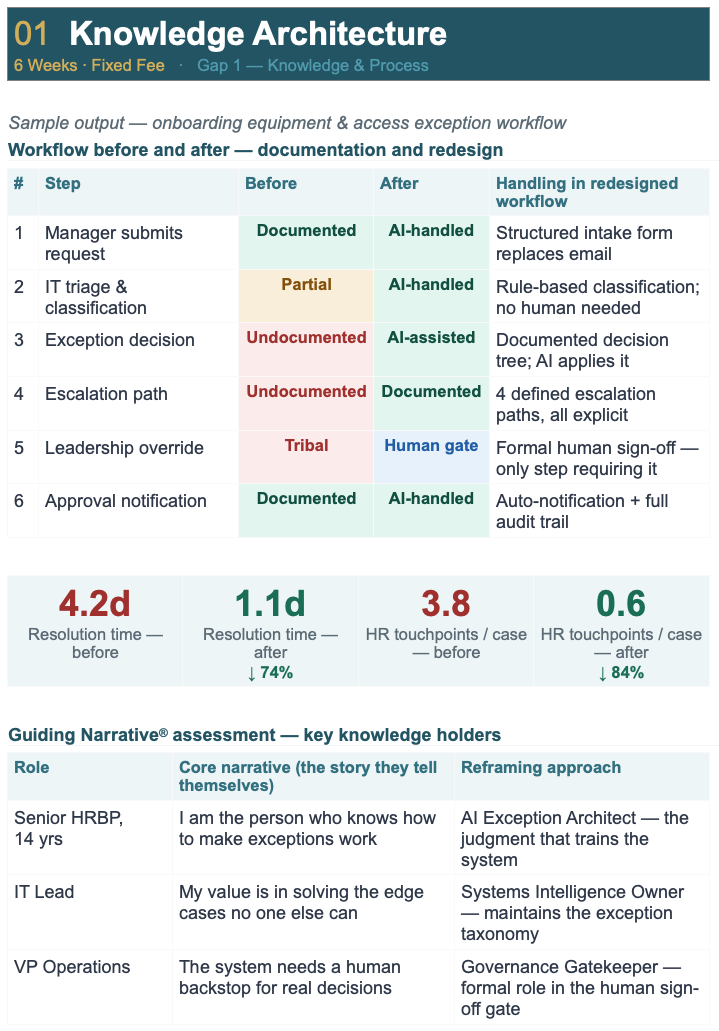
- Workflow redesign documentation: before/after mapping of the target workflow, with every step classified as AI-handled, AI-assisted, documented, or human gate.
- Guiding Narrative® assessment: for each key knowledge holder: their core narrative and a specific reframing approach that makes knowledge contribution feel like legacy-building, not self-obsolescence.
- Role reframing playbook: new role definitions that give senior experts elevated ownership of the judgment that will run the firm for the next decade
- Exception taxonomy: a structured record of the decision rules, escalation paths, and edge cases that currently live only in people’s heads
Example: Before and After a Knowledge Architecture Sprint