Sprint 02
Rewire the Data
Data Quality Foundation: Your HR Data Wasn’t Built for AI
6 Weeks · Fixed Fee
Your HR data looks fine…until AI arrives.
Ask your CHRO and CFO separately how many people work at your company. Unless you engage in a detailed discussion, you’ll still often get two different numbers.
Neither number is wrong, exactly. But one of those numbers must reconcile to an audited financial statement. The other lives wherever the HRIS put it, governed by no external forcing function.
That asymmetry is harmless when employees are doing the interpreting. It becomes a structural problem the moment an AI system tries to reason over your workforce data.
And the pattern doesn’t stop at headcount—extend it across every dataset HR owns: skills, performance, compensation, engagement, career history, contractor records, learning histories. Wherever data isn’t strictly required for legal compliance or financial reporting, quality is materially worse than most people assume.
It’s Not a Data Quality Problem. It’s a Design Problem.
HR data is narrative-heavy and free of audit discipline. Designed for humans to interpret, not for autonomous systems to reason over, it creates a structural liability today.
When job titles are inconsistent, reviews are stale, and contractor records are invisible to the system, your AI guesses, when you task it to distribute tasks, map skills, or plan your workforce. The outcome: dashboards look clean, but the underlying logic is broken.
The failure isn’t an error message—it is a plausible-looking output built on a phantom foundation. By the time you notice, you’ve already presented broken recommendations to your CEO.
Stop running basic data cleanups. You must re-architect your data with the same design discipline Finance applies to the general ledger.
The Solution:
Fix the Data Challenge—Without Replacing Your HRIS
Most data initiatives in HR come in two flavors: a data cleaning exercise that fixes symptoms without addressing architecture; or an HRIS replatforming project that takes 18 months and delivers a new system with the same underlying wiring failures.
The Data Quality Foundation sprint takes a different approach:
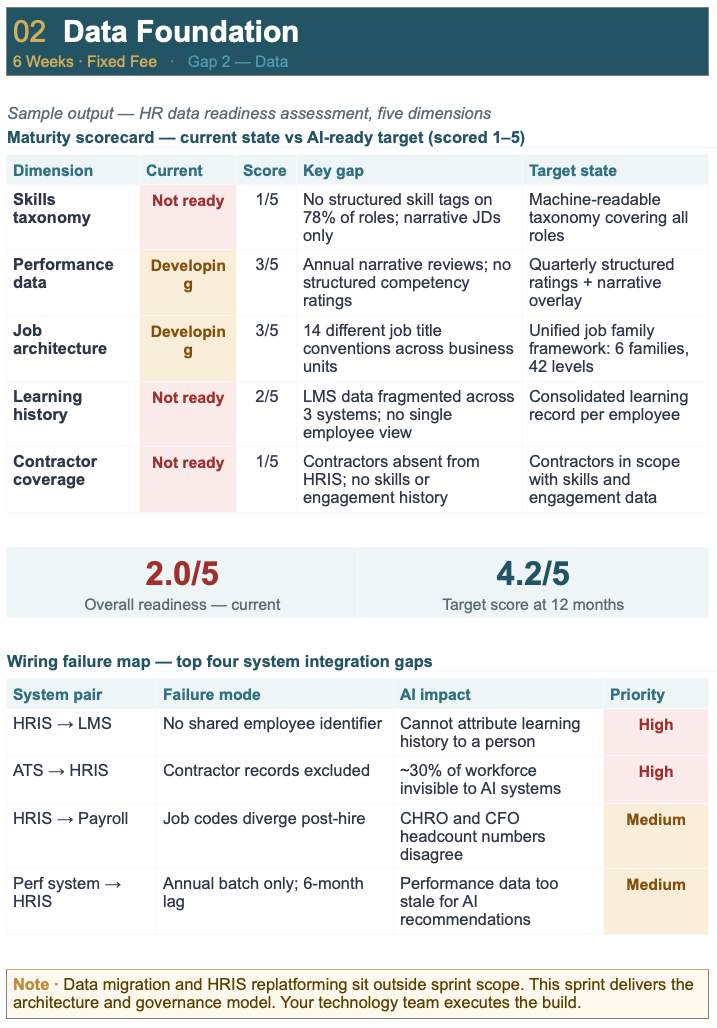
- We start with a diagnostic that maps the five dimensions of HR data readiness—skills taxonomy, performance data, job architecture, learning history, and contractor coverage—against a scored maturity framework.
- We then build a data failure map that identifies exactly where system integration gaps are creating invisible capability holes. Unlike a gap analysis that tells you what’s missing, the data failure map tells you which specific breaks have which specific AI impacts—and which ones to fix first.
- From there, we design the target architecture—the connected data model your AI investments need to function—and build the governance model that keeps it machine-readable over time.
Outcome
The technology build sits with your team. What we deliver is the architecture and governance specification they need to build it right.
Deliverables
- Data readiness scorecard: maturity ratings across five HR data dimensions, scored against an AI-ready target state with a current vs. target gap for each
- Data failure map: the specific system integration gaps that are creating invisible capability holes, with AI impact ratings and a prioritized fix sequence
- Target data architecture: the connected data model your AI use cases require, designed around your existing systems rather than a replatforming requirement
- Data governance model: the standards, ownership assignments, and review cadence that keep your HR data machine-readable as the workforce and the tools evolve
Example: Before and After a Data Quality Foundation Sprint