Sprint 03
Own the Architecture
Vendor Coordination: The Front-Door Decision Is Already Being Made
4 Weeks · Fixed Fee
Every major vendor is competing to own your employee experience. Open any enterprise application your employees use today and you’ll find it: an AI assistant tab, a Copilot button, a “powered by AI” badge. Salesforce, ServiceNow, Workday, Microsoft, Google, SAP, as well as a new cohort of pure-play agent platforms (Glean, Sierra, Console, and dozens of others)—each is racing to become the place where work starts, the “front door” through which every process is launched.
These vendors know something most buyers haven’t fully processed: once a tool is the front door to a core workflow, switching costs spike. As one executive put it plainly: “even mediocre software wins on inertia.”
What the Vendor Coordination Breakdown Costs You
Every vendor claims primary interface rights, leaving you with a hallway of competing front doors that cannot coordinate. This isn’t a prompt-engineering fix—it is a fundamental architecture problem that won’t resolve itself next quarter.
When this vendor chaos becomes visible, HR absorbs the blame. AI Adoption stalls, the CEO demands ROI, and unapproved shadow AI embeds itself into daily workflows. Every informal pilot or month-to-month contract raises the cost of realignment, as well as possibility of legal exposure. What looks like a low-commitment experiment quickly becomes unsanctioned infrastructure you cannot remove.
The question isn’t which AI tools to adopt. It’s which vendor’s front door your employees will live behind for the next decade—and whether that choice will be yours or theirs.
The Solution:
Make that Front-Door Decision Your Own
Most organizations approach vendor consolidation either too broadly—an eighteen-month project that loses momentum—or too narrowly, evaluating individual tools without seeing the architectural stakes.
The Vendor Coordination sprint is designed to reach a defensible position, before the next contract conversation puts you on the back foot:
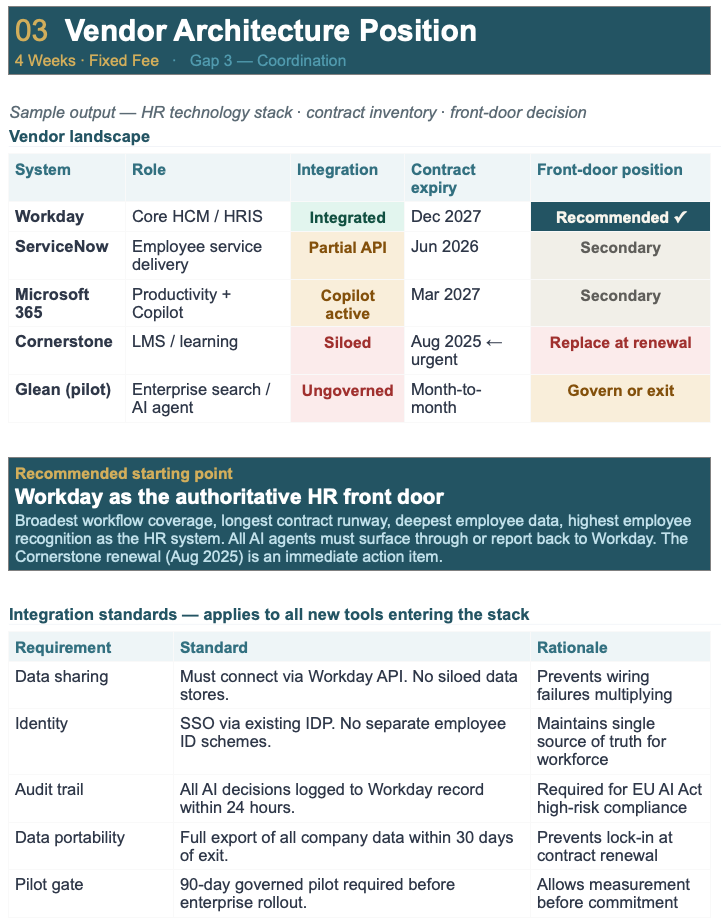
- We start with a structured inventory of your HR technology stack: every system with an AI layer or agentic capability, its integration status, its contract timeline, and its current position in employee workflows.
- We map where the front-door competition is already playing out inside your environment, where ungoverned tools have become shadow infrastructure, and which renewal decisions have architectural consequences you may not have fully mapped.
- From there, we make a front-door recommendation: which system should be the authoritative interface for HR processes, what integration standards to require of any new tool entering the stack, and where the employee experience governance should live.
Outcome
The output isn’t a vendor ranking—it’s a position your HR, IT, and Legal teams can hold when the next vendor comes calling.
Deliverables
- Vendor landscape map: every system in your HR stack with an AI or agentic layer, its integration status, contract expiry, and current front-door position
- Contract inventory: a prioritized view of which renewals are urgent, which tools are month-to-month risks, and where lock-in is already forming
- Front-door decision: a clear, defended recommendation for which system is the authoritative HR interface, with the rationale your CEO, CFO, and IT leadership can align behind
- Integration standards: the requirements any new tool must meet before entering the stack: data sharing, identity, audit trail, portability, and pilot governance
Example: Before and After a Vendor Coordination Sprint