Sprint 04
Fix Your AI Output
AI Adoption: Stop Improvising Without a Net
8 Weeks · Fixed Fee
Strip away the headlines and most employees genuinely want AI to work. A recent EY survey found 84% of workers are eager to use agentic AI in their roles. But a majority say the organizations pushing AI on them never gave them the tools, training, or time to actually learn how to use it well.
So they improvise. Willing people fill the vacuum themselves—learning in the margins of an already-full day, copying whatever a colleague seems to be doing, and trusting outputs they have no reliable way to check.
But improvisation without support has no net: no shared norms for when AI can be trusted and when a human must decide, no protected time to build the judgment that separates good output from plausible-looking output, and no safe way to say “this came out wrong.” So mistakes go unspoken, workarounds spread, and the work looks finished without being sound. Willingness alone doesn’t produce good AI collaboration; the conditions around it do.
What “Workslop” Actually Costs You
Anxious employees are using AI to look productive rather than to be productive. The result is what Kate Niederhoffer and her collaborators at BetterUp call “workslop”: low-quality, performative AI output produced by people told to use the tools but never given the conditions to use them well.
The cost shows up upstream—in management rework, lengthened review cycles, and eroded trust when colleagues can’t tell if work was thought through or auto-generated. Eventually, it surfaces as the CEO asking why AI investments aren’t moving the numbers.
AI operates on a jagged frontier, brilliant yet unreliable. More software licenses or training videos won’t fix this. You don’t close this gap with technology upgrades; you close it by adding structural norms, time, and team coordination.
The Solution:
Build Real Adoption—Not Another Training Rollout
Most adoption programs lead with toolkits, communication campaigns, and modular e-learning. Those have their place, but they describe activity, not outcomes—and they leave the jagged frontier exactly where it was.
The AI Adoption sprint takes the opposite approach by using the tools, in real conditions, with real stakes, on a timeline short enough to produce learning you can act on:
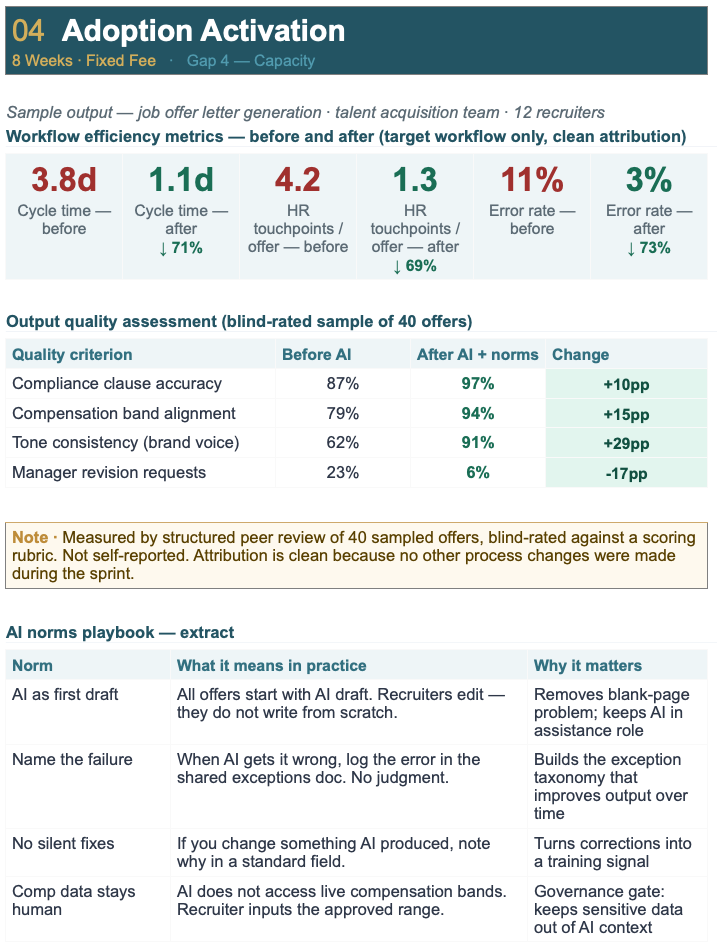
- We pick one workflow that matters, redesign and run it. We establish explicit AI norms—when AI drafts and when a human decides, how errors and issues get logged without blame, what data AI is never allowed to touch—so people can use the tools honestly instead of defensively.
- We train Collaboration Architects: employees fluent in both the tools and the specific workflow, given explicit authority to bridge strategy and execution and to keep the norms alive after we leave.
- And we measure clean, attributable before-and-after results on that one workflow, so the value is provable rather than asserted.
Outcome
The result isn’t a workforce that has heard about AI. It’s a team that has demonstrated, through its own work, what good AI collaboration looks like—and a playbook for repeating it on the next workflow without us.
Deliverables
- AI working-norms playbook: the explicit operating rules for human–AI collaboration on the target workflow: where AI drafts, where a human decides, how errors are surfaced and turned into a training signal, and what data stays off-limits
- Collaboration Architects: named employees, engaged in both the tools and the workflow, equipped and authorized to bridge strategy and execution and to sustain adoption after the sprint ends
- Live workflow results: clean, attributable before-and-after metrics on one real workflow (cycle time, touchpoints, error and quality rates), measured by structured review rather than self-report
- Replication playbook: the step-by-step method your team uses to run the same activation on the next workflow, so capacity-building becomes a repeatable internal capability, not a dependency on us
Example: Before and After an AI Adoption Sprint